Zhulong (Torch Dragon) 烛龙
zhú lóng · Wade-Giles: chu-lung
Deity 神
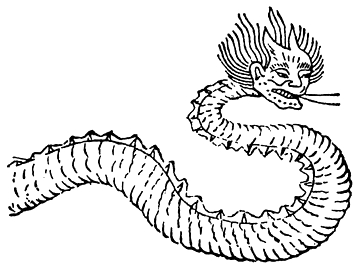
📜 Source Text 原文出处
海外北经 · 钟山之神烛阴 · Classic of Regions Beyond the Seas: North
钟山之神,名曰烛阴,视为昼,瞑为夜,吹为冬,呼为夏,不饮,不食,不息,息为风,身长千里。在无䏿之东。其为物,人面,蛇身,赤色,居钟山下。
The god of Mount Zhong is named Zhuyin, the Torch Shade. When he looks, there is day; when he shuts his eyes, there is night. When he blows, there is winter; when he exhales, there is summer. He does not drink, does not eat, does not rest — and still his breath becomes wind. His body is a thousand li long. He dwells east of the land of Wuqi. In form he has a human face and a serpent's body, red of color, and he lives beneath Mount Zhong.
西北海之外,赤水之北,有章尾山。有神,人面蛇身而赤,直目正乘,其瞑乃晦,其视乃明,不食不寝不息,风雨是谒。是烛九阴,是谓烛龙。
Beyond the sea at the northwest, north of the Red River, stands Mount Zhangwei. There is a god there with a human face on a red serpent's body, his eyes set straight and narrow: when he closes them, darkness falls; when he opens them, there is light. He neither eats nor sleeps nor rests, and wind and rain answer his summons. He it is who torches the Nine Darknesses — and this is called the Torch Dragon.
From the Classic of the Great Wilderness: North (大荒北经)
日安不到,烛龙何照。
Where does the sun never reach — and what is it that the Torch Dragon shines upon?
From the Chu ci, 'Heavenly Questions' (楚辞 · 天问), c. 3rd century BCE
烛龙在雁门北,蔽于委羽之山,不见日,其神人面龙身而无足。
The Torch Dragon lies north of Yanmen Pass, hidden beneath Mount Weiyu where the sun never shows. Its spirit has a human face and the body of a dragon — and no feet at all.
From the Huainanzi, 'Treatise on Topography' (淮南子 · 墬形训), c. 139 BCE — note the dragon-body, footless variant
Modern location: The mythic far northwest beyond the northern seas; no agreed real-world location
📝 Summary
Zhulong (烛龙), the Torch Dragon or Zhuyin (烛阴), is the god of Mount Zhong in the Classic of Mountains and Seas: a thousand-li red serpent with a human face whose opening eyes make day, whose closing eyes make night, whose breath turns the seasons. He neither drinks nor eats nor rests, and ranks among the highest gods of the classic, a forerunner of the Pangu creation myth.
🎨 Appearance
A red serpent a thousand li long with a human face, eyes set in vertical slits, no wings and no legs. The classic itself gives him a snake's body (蛇身); the Huainanzi upgrades him to a footless dragon's body (龙身而无足); Han and later commentators imagine him holding a torch or fire-essence in his mouth to light the sunless north.
✨ Abilities
- Gaze of day and night — when he opens his eyes it is day; when he closes them, night falls
- Breath of the seasons — his blowing makes winter, his exhaling makes summer; his very breath becomes wind
- Needless existence — he does not drink, eat, or sleep, yet the world keeps time by him
- Mastery of storm — wind and rain answer his summons (风雨是谒)
- Torch of the Nine Darknesses — his light reaches where the sun never shines
🏮 Symbolism
The cosmic clock: day, night, winter, and summer riding on a single face — time itself made god, and a red bridge between creation and the dark. Han commentators fused him with the torch-bearing dragon who lights the sunless, underworld-flavored north (幽冥无日之国), so he stands on the border between light and the Netherworld. Modern angles: he is a favorite 'time dragon' in games and anime, the eyes-open-it-is-day beat is endlessly quoted in Chinese web novels, and Shanghai studio Aurogon (上海烛龙) even took his name as the developer of the Gujian series.
🎬 Cultural References
| Work | Year | Note |
|---|---|---|
| Chu ci, 'Heavenly Questions' (楚辞 · 天问) | c. 3rd century BCE | 'Where the sun never reaches, what does the Torch Dragon shine upon?' — the first literary allusion, centuries before Pangu was written down |
| Huainanzi, 'Treatise on Topography' (淮南子 · 墬形训) | c. 139 BCE | Recasts him as a footless, dragon-bodied god hidden north of Yanmen where the sun never shines |
| Li Bai, 'North Wind' (李白 · 北风行) | c. 752 | Opens with the Torch Dragon nesting at the Cold Gate whose light still dawns — the auroral image enters Tang poetry |
| Xuan-Yuan Sword V (轩辕剑伍) | 2006 | DOMO's RPG features Zhuyin straight from the Shanhaijing bestiary |
| Chimeraland (妄想山海) | 2021 | Open-world game where Zhulong the creation god dwells on Mount Zhangwei, guarding the legendary Xuanyuan Sword |
| Aurogon Shanghai (上海烛龙) | 2007 | The developer of the Gujian (古剑奇谭) series took the Torch Dragon's name for its studio |
The Highest God of the North
The Classic of Mountains and Seas describes the supreme deity of the northern world twice, in two different books. The Classic of Regions Beyond the Seas: North calls him Zhuyin, the god of Mount Zhong; the Classic of the Great Wilderness: North calls him Zhulong, the Torch Dragon, of Mount Zhangwei. Everything about the two descriptions matches — the human face, the red serpent body, the refusal of food and sleep, the lighting of darkness — and early readers already fused them. The 3rd-century commentator Guo Pu glossed the first passage with a single note: “the Torch Dragon — he torches the Nine Darknesses, and is named from this.” The Qing philologist Hao Yixing, in his Shanhaijing jianshu (山海经笺疏), treated Mount Zhong and Mount Zhangwei as one mountain and the two names as one god. What we cannot recover is whether the two passages descend from a single older source or were harmonized by exactly such commentators.
A Face on a Thousand-Li Serpent
He is a thousand li long — roughly five hundred kilometers — a creature that is also a landscape. His face is human; his body is the red of embers. The Great Wilderness passage adds the enigmatic phrase “straight eyes, upright-cheng” (直目正乘): Guo Pu explained the straight eyes as vertical ones (目纵) and confessed, with rare honesty, that he had never heard what zheng cheng meant. Later phonologists have proposed reading cheng (乘) as a loan for zhen (朕), “a straight seam” — eyes that shut into a single narrow slit — but the phrase remains unsettled, and this bestiary will not pretend otherwise. His body, too, shifts between sources: the Shanhaijing itself gives a snake’s body (蛇身), while the Huainanzi gives a dragon’s body with no feet (龙身而无足); Guo Pu, quoting a lost edition, even transmitted the reading “dragon body, one foot,” which Hao Yixing dismissed as a scribal slip.
The Dragon Before Pangu
No other creature in the classic commands the functions of the cosmos itself. Day and night turn on his eyelids; winter and summer ride on his breath; wind is the exhaust of his existence. This is creation-grade mythology, and the great 20th-century collator Yuan Ke argued that the much later Pangu myth — first written down by Xu Zheng’s Sanwu lianji (三五历记) in the 3rd century CE — grew out of precisely this older stratum: when the giant Pangu dies, his eyes become sun and moon and his breath the wind and weather, a physiology the Torch Dragon had already embodied a thousand years earlier in writing. A rival, naturalistic current in modern scholarship reads the thousand-li red serpent flickering over the polar night as a memory of the aurora borealis; it is an attractive guess, and only a guess. Around the god clusters an underworld imagery: the Chu ci sends the soul away from the north, where “the Coiling Dragon glows red” on the Cold Mountain (逴龙, usually read as Zhulong); Wang Yi’s Eastern Han commentary describes “a dark, sunless land in the northwest of the sky, with a dragon holding a torch to light it”; the Han apocryphon Shi han shenwu (诗含神雾) sends “a dragon carrying a fire-essence in its mouth to light the Gate of Heaven”; and Gao You’s commentary on the Huainanzi completes the fusion — “the dragon holds a torch to light the moon-darkness, some thousand li long.” Tellingly, the Great Wilderness: North plants Mount Zhangwei in the same landscape as the Nine Yin Mountain (九阴山) and the red Ruo tree (若木) of sunset — the dragon who torches the Nine Darknesses dwells beside the geography of dusk.
Modern Torchlight
The Torch Dragon has become the default Chinese “time dragon.” Xuan-Yuan Sword V (2006) put Zhuyin on screen straight from the bestiary; the open-world game Chimeraland (2021) made him a creation god on Mount Zhangwei, the myth’s own mountain; and Shanghai’s Aurogon studio — 上海烛龙, literally “Shanghai Torch Dragon” — took his name before building the Gujian series. In Chinese web fiction the formula “his eyes open — it is day; his eyes shut — it is night” (睁眼为昼,闭眼为夜) has become a stock phrase for world-shaking beings, and anime-style games cast him as an ancient dragon of time. Few readers of those scenes may know how much of the trope is verbatim three centuries before the common era.
🎲 D&D 5E: See the full stat block in the lore box below. CR 24 titan, neutral.
🎲 D&D 5E Stat Block
AC 20 (natural), HP 455 (26d20+182), Speed 60 ft., burrow 60 ft., fly 120 ft. (hover). STR 26, DEX 16, CON 24, INT 18, WIS 22, CHA 24. Legendary Resistance (5/Day), Magic Resistance, Cosmic Existence (needs no food, drink, sleep, or air — his breath is the wind). Multiattack: 2 bites +14 (2d10+8 piercing) plus tail sweep +14 (3d8+8 bludgeoning, DC 22 Str or pushed 20 ft. and knocked prone). Breath of Seasons (Recharge 5-6): 90-ft. cone, DC 22 Con, 45 (10d8) fire (summer) or cold (winter), target's speed halved until end of its next turn. Turn of the World (Recharge 6): opens one eye — 300-ft. radius becomes blinding day, DC 22 Wis or blinded 1 min — or closes it — 300-ft. magical darkness, DC 22 Wis or fall unconscious 1 min.