Kua Fu 夸父
kuā fù · Wade-Giles: k'ua-fu
Deity 神
📜 Source Text 原文出处
山海经 · 海外北经、大荒北经 · Classic of Regions Beyond the Seas: North; Classic of the Great Wilderness: North
夸父与日逐走,入日。渴,欲得饮,饮于河、渭;河、渭不足,北饮大泽。未至,道渴而死。弃其杖,化为邓林。
Kua Fu raced the sun at a run, and entered the sun. Parched, he wanted a drink: he drank from the Yellow River and the Wei; the Yellow River and the Wei were not enough, so he turned north to drink the Great Marsh. He never arrived. On the road he died of thirst. He cast aside his staff, and it became the Forest of Deng.
大荒之中,有山名曰成都载天。有人珥两黄蛇,把两黄蛇,名曰夸父。后土生信,信生夸父。
In the midst of the Great Wilderness stands a mountain called Chengdu Supports Heaven. There is a man there who wears two yellow snakes through his ears and grips two yellow snakes in his hands. His name is Kua Fu. Houtu begat Xin, and Xin begat Kua Fu.
夸父不量力,欲追日景,逮之于禺谷。将饮河而不足也,将走大泽,未至,死于此。应龙已杀蚩尤,又杀夸父,乃去南方处之,故南方多雨。
Kua Fu, not measuring his strength, wished to chase the sun's shadow and caught up with it at the Valley of Yu. He was about to drink from the Yellow River, but it would not suffice; he was about to run to the Great Marsh, but before arriving he died here. Yinglong had already slain Chiyou, and went on to slay Kua Fu; then he departed to dwell in the south — which is why the south receives so much rain.
Modern location: The 'Forest of Deng' was identified by the Qing scholar Bi Yuan with the Peach Forest (桃林) near modern Lingbao, Henan, west of the Hangu Pass
📝 Summary
Kua Fu (夸父) is the giant of the Classic of Mountains and Seas who raced the sun across the sky, drank the Yellow River and the Wei dry, and died of thirst on the road — whereupon his abandoned staff grew into a forest. For two millennia Chinese readers have argued over whether he is a warning or an inspiration; in 2022, China named a solar observatory satellite after him.
🎨 Appearance
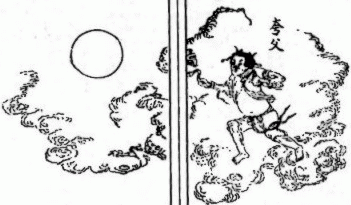
A colossus among men, 'great of body,' with two yellow snakes hung through his ears and two more gripped in his fists — the regalia of a divine giant — a wooden staff in his hand, his throat burning as he runs. The men of the land of Kua Fu, east of the Long-Eared people, are likewise gigantic: green snake in the right hand, yellow snake in the left.
✨ Abilities
- Sun-sprint — ran down the sun itself; the Great Wilderness version says he caught the sun's shadow at the Valley of Yu where it sets
- River-draught — drained the Yellow River and the Wei in single draughts, and still thirsted for the Great Marsh
- Snake regalia — wears two yellow snakes as earrings and grasps two more in his hands, badges of a giant's divine rank
- Staff to forest — his cast-off staff rooted and became the Forest of Deng; the Liezi adds that the wood, steeped in the fat of his corpse, spread several thousand li
- Lineage of earth — grandson of Houtu, 'Sovereign Earth'; the folk of his eponymous land are giants to match
🏮 Symbolism
Doomed ambition and heroic striving in one body — the textbook case of 不自量力 (not measuring one's strength) and, at once, the Chinese archetype of the will that challenges nature itself. Tao Yuanming (c. 400 CE) praised his 'grand design'; the Qing philologist Bi Yuan glossed Deng Forest as the Peach Forest (deng being a sound-loan for peach); in the 1950s Yuan Ke's retelling made him a hero of the laboring people in the 'man conquers nature' years, answered ironically by Yu Kwang-chung's modernist poem. Modern afterlives: the idiom kuā fù zhú rì for grand, quixotic endeavors; a Star-God in the 2005 TV drama Jingwei Fills the Sea; China's ASO-S solar observatory Kuafu-1 (2022); and a recurring sun-chaser figure in mythology-themed games and tattoo art.
🎬 Cultural References
| Work | Year | Note |
|---|---|---|
| Liezi, 'Tangwen' (列子·汤问) | Warring States text | Retells the chase and adds the ecopoetic detail: the staff, steeped in the fat of the giant's corpse, grew into a forest 'several thousand li wide' |
| Tao Yuanming, 'Reading the Classic of Mountains and Seas, no. 9' (读山海经·其九) | c. 400 CE | 'Kua Fu was born with a grand design, and raced the sun on foot' — the fountainhead of the heroic reading |
| Yuan Ke, Myths of Ancient China (中国古代神话) | 1950 | Recast Kua Fu as a hero of the laboring people battling nature — the Mao-era 'man conquers nature' reading |
| Yu Kwang-chung, 'Kua Fu' (夸父) | 20th c. | Modernist counter-reading: why strain to save the dusk, when the dusk is only the sun's retreating shadow? |
| Jingwei Fills the Sea (精卫填海, TV series) | 2005 | Kua Fu as the Star God, a major divine figure guarding the constellations |
| Kuafu-1 (夸父一号), ASO-S solar observatory | 2022 | China's first dedicated solar satellite; a third of 25,000 public naming proposals chose 'Kua Fu' |
A Race Against the Sun
The whole story runs to fifty characters, and it reads like a myth that knew it would be retold forever. In the Classic of Regions Beyond the Seas: North, Kua Fu 逐走 — chases at a full run — and 入日: enters the sun. Whether that means he caught it at the horizon or ran bodily into its burning disc, the text does not pause to say. Thirst, not fire, is what defeats him. He drinks the Yellow River and the Wei down to their beds, turns north toward the Great Marsh, and dies on the road. Then the passage spends its final seven characters on the most famous ending in the entire Classic: 弃其杖,化为邓林 — he cast aside his staff, and it became the Forest of Deng. No moral is appended. A dead giant simply blooms.
Two Deaths, One Giant
The Classic of the Great Wilderness: North tells it again, and disagrees about the ending. It gives Kua Fu a mountain — Chengdu Supports Heaven — a pedigree, and a dress code: he is the grandson of Houtu, ‘Sovereign Earth,’ and he wears two yellow snakes through his ears while gripping two more in his hands. A neighboring passage sets the land of Kua Fu (a variant reading gives Bo Fu 博父) east of the Long-Eared people, its inhabitants ‘great of body,’ the Forest of Deng lying to their east. But this second telling also slips in a second, incompatible death: after Yinglong killed Chiyou in the Yellow Emperor’s wars, ‘he went on to slay Kua Fu,’ then withdrew south, ‘which is why the south receives so much rain.’ The giant who drank rivers dry is finished off by the rain-dragon itself. Later tradition, and modern mythographers such as Yuan Ke, suspect Yinglong belongs to the same archetypal family as Zhulong, the torch-dragon of the northern dark (see the entry on this site) — a convenience of comparison, not a settled fact. The honest position is that the Classic grew in layers; the two Kua Fus are two strata of one archetype.
Folly or Grandeur
The earliest verdict on the giant is embedded in the Great Wilderness text itself: 不量力, ‘not measuring his strength.’ The Liezi retells the chase under the same shadow, adding only that the staff, steeped in the fat of the corpse, became a forest several thousand li wide. The heroic reading is younger but unstoppable: Tao Yuanming, around 400 CE, opens his ninth ‘Reading the Classic of Mountains and Seas’ with ‘Kua Fu was born with a grand design, and raced the sun on foot,’ and closes it by noting that his achievement outlived him — 功竟在身后. The Qing philologist Bi Yuan tried to pin the myth to the map, glossing Deng Forest as the Peach Forest (deng being a sound-loan for peach) by the Hangu Pass; the Classic itself, in the Classic of the Central Mountains, sets a Peach Forest of three hundred li square north of a Mount Kua Fu, which lends the gloss real support. In the 1950s, mainland mythography — above all Yuan Ke’s Myths of Ancient China (1950) — recast Kua Fu as a hero of the laboring people wrestling nature into submission, a reading that marched with the era’s ‘man’s will conquers heaven and earth’ rhetoric. Yu Kwang-chung’s modernist poem ‘Kua Fu’ turned the irony around again: why strain to save the dusk at all, when the dusk is only the sun’s retreating shadow?
From Idiom to Orbit
The idiom kuā fù zhú rì (夸父逐日) now sits in dictionaries with both senses at once — a grand ambition, and a fatal overreach — which is as good a summary as any of the argument above. In the 2005 television drama Jingwei Fills the Sea he appears as the Star God, guardian of the constellations; across Chinese mythology-themed games he recurs as the ur-sun-chaser, staff in hand. In October 2022 the naming became literal: China’s first dedicated solar observatory, the Advanced Space-based Solar Observatory, entered orbit as Kuafu-1 — and when the state had solicited names from the public, a third of the 25,000 proposals said the same thing. The man who died of thirst pursuing the sun is now a machine that watches it without blinking; somewhere between those two images, the staff is still flowering.
🎲 D&D 5E: See the full stat block in the lore box below. CR 17 giant (titan), chaotic neutral.
🎲 D&D 5E Stat Block
AC 18 (natural), HP 262 (21d12+126), Speed 60 ft. STR 28, DEX 16, CON 22, INT 12, WIS 16, CHA 18. Legendary Resistance (3/Day), Magic Resistance, Siege Monster. Multiattack: 2 staff slams +13 (3d10+9). Solar Sprint (Recharge 5-6): moves up to 120 ft. in a straight line through occupied spaces; each creature in the path DC 23 Str save, 40 (9d8) bludgeoning damage and knocked prone. Draught of Rivers (Recharge 6): drinks a river or lake dry, regaining 100 HP; creatures caught in the water take 22 (4d10) force damage.