Tiangou 天狗
tiān gǒu · Wade-Giles: t'ien-kou
Strange Being 异人
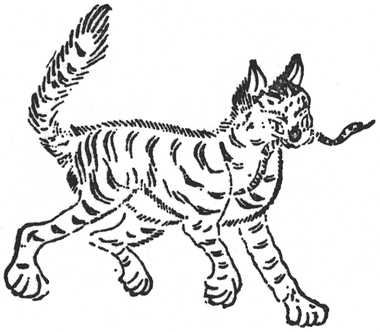
📜 Source Text 原文出处
西山经 · 西次三经 / 阴山 · Classic of the Mountains: West, Third Circuit — Mount Yin
又西三百里,曰阴山。浊浴之水出焉,而南流注于蕃泽,其中多文贝。有兽焉,其状如狸而白首,名曰天狗,其音如榴榴,可以御凶。
Three hundred li further west stands Mount Yin. The River Zhuoyu rises from it and flows south into the Marsh of Fan, where patterned cowries grow in plenty. A beast dwells there shaped like a wildcat, but with a white-crowned head. Its name is the Heavenly Dog; its cry rolls like 'liu-liu' — the chattering of a cat — and its presence can keep misfortune at bay.
天狗,状如大奔星,有声,其下止地,类狗。所堕及,望之如火光炎炎冲天。其下圜如数顷田处,上兑者则有黄色,千里破军杀将。
The Heavenly Dog is shaped like a great shooting star. It gives off a sound as it falls, and where it comes down to earth it is shaped like a dog. Wherever it strikes, watchers see a blaze like firelight leaping skyward. The ground below lies in a circle wide as several hundred qing of fields; where its tip burns yellow, it will break armies and slay generals a thousand li around.
From the Treatise on the Celestial Offices (天官书) in Sima Qian's Records of the Grand Historian (史记, c. 90 BCE); Meng Kang glosses it as a tailed star with a dog-shape beneath, 'also an emanation of the metal star Venus'
吴楚七国叛逆,彗星数丈,天狗过梁野;及兵起,遂伏尸流血其下。
When the seven states rose in rebellion, a comet several zhang long appeared, and a Heavenly Dog passed over the fields of Liang. War followed, and beneath its path the ground was heaped with corpses and running with blood.
Records of the Grand Historian, on the Rebellion of the Seven States, 154 BCE — a named tiangou omen tied to a datable event
Modern location: Unlocated; modern commentators variously propose sites in Gansu, Xinjiang, or Qinghai, and Fan Marsh is sometimes identified with a lake in the Qaidam Basin
📝 Summary
The tiangou (天狗) of the Classic of Mountains and Seas (c. 4th century BCE) is a white-headed wildcat whose presence wards off evil — an auspicious ward, not a monster. Centuries later the name attached to a dog-shaped falling star of war, and folklore made it the hound that swallows the moon. It has nothing to do with Japan's long-nosed tengu — though anime keeps insisting otherwise.
🎨 Appearance
A wildcat- or leopard-cat-sized beast with a white-crowned head and darker flanks, ears pricked, fangs bared mid-snarl. No wings, no feathers, no long nose — anything with those belongs to the Japanese tengu, a different creature altogether.
✨ Abilities
- Ward against evil (御凶) — its mere presence turns back malignant forces; the text says simply that it 'can ward off misfortune'
- Cry of 'liu-liu' — its voice rolls like a cat's chatter; the received graph 榴榴 is onomatopoeic, and Guo Pu already records a variant reading 猫猫, a mew
- Star-fallen form (史记) — in Han omenology the tiangou hurtles down as a blazing meteor-dog; where its tip burns yellow, 'armies are broken and generals slain for a thousand li'
- Eclipse hound (later folklore) — from the war-star grew the popular belief in a heavenly dog that swallows the sun and moon, to be driven off by drum and gong
- Kin of warding beasts — the same classic credits the huan 讙 and the fish ran yi 冉遗 with the same power (可以御凶), placing the tiangou in a class of guardian animals
🏮 Symbolism
A living amulet against ill fortune; its white head and its later identity as an emanation of Venus (太白之精) tie it to metal, the west, and autumn. Modern angles: in anime and games — the red-faced, long-nosed tengu of Japanese folklore, the crow-tengu of yokai bestiaries, titles like Nioh — 'tiangou/tengu' now conjures the Japanese mountain goblin for most of the world, an image that has flooded back into Chinese usage and all but buried the original white-headed warding beast.
🎬 Cultural References
| Work | Year | Note |
|---|---|---|
| Records of the Grand Historian (史记 · 天官书) | c. 90 BCE | Sima Qian's tiangou is a dog-shaped falling star of war — the source of the baleful 'Heavenly Dog' omen |
| Book of Han, Treatise on Celestial Patterns (汉书 · 天文志) | 1st century CE | Ban Gu's history keeps the dog-star entry, fixing the tiangou in official omen lore |
| Nihon Shoki (日本书纪) | 720 | Japan's oldest chronicle writes 天狗 tengu for a meteor — the Chinese loanword kept its astronomical sense after crossing the sea |
| Konjaku Monogatarishū (今昔物语集) | c. 1120 | Japanese tales cast the tengu as a mountain demon and the vengeful spirit of proud monks — the birth of the familiar yokai |
| Gikeiki (义经记) | c. 1400 | The tengu king Sōjōbō of Mount Kurama teaches swordsmanship to the boy Yoshitsune — the classic medieval tengu legend |
| Nioh 2 | 2020 | Karasu-tengu yokai fights — for most Western players the Japanese goblin is simply what a 'tiangou' is |
The White-Headed Guardian of Mount Yin
The Classic of Mountains and Seas, in its Third Circuit of the Western Mountains, gives the tiangou a single breath: a beast on Mount Yin, shaped like a li 狸 — a wildcat or leopard-cat — but with a white head, crying “liu-liu,” whose presence “can ward off evil” (可以御凶). It belongs to a recognized class in the classic: the one-eyed, three-tailed huan 讙 and the serpent-headed fish ran yi 冉遗 are likewise said to keep misfortune at bay. Nothing in the passage is monstrous; the tiangou is closer to a temple guardian than to a demon.
The fourth-century commentator Guo Pu already flags the wobble in the text: some manuscripts give the body “like a leopard” (或作豹) rather than a wildcat, and the cry “mao-mao,” a cat’s mew (或作猫猫), rather than “liu-liu.” The mountain itself is unlocated. Modern commentators have proposed sites in Gansu, Xinjiang, or Qinghai, and one tradition would set Fan Marsh beside a lake in the Qaidam Basin. Note, too, that the same classic opens its Fourth Western Circuit with a second Mount Yin, drained by rivers flowing to the Luo — whether one mountain or two bears the name, the text leaves open.
A Dog-Shaped Star
By the time Sima Qian wrote the Treatise on the Celestial Offices (c. 90 BCE), the Heavenly Dog had left the mountains for the sky. There it is a falling star with a tail, a short comet at its side, and a hound’s shape beneath — “also an emanation of the metal star Venus” in Meng Kang’s Han gloss, the five-phase logic that lets this entry carry the metal element. Where it landed, the ground burned in a circle several hundred qing across, and a yellow-tipped blaze foretold armies broken and generals slain a thousand li around. The historian even ties the omen to a date: in 154 BCE, as seven states rose against the Han throne, a comet stretched several zhang and a tiangou crossed the fields of Liang — and war came.
The Hound That Swallows the Moon
From that war-star, Chinese folk belief built its most famous dog. By medieval times the “Heavenly Dog” was the creature that swallows the sun and moon: during an eclipse, villagers beat drums, struck gongs, and raised a din to frighten it into spitting the luminaries back out. The custom is genuine and widespread — but a note of honesty is owed: no such eclipse-hound appears in the early classics. It grows from Han omenology and later storytelling; one popular tale makes the dog the faithful hunting hound of the archer Hou Yi, who licked up his master’s leftover elixir and flew skyward to harry the moon. The Shan Hai Jing’s gentle warding beast and the sky-darkening monster never quite reconcile.
A Japanese Namesake, and the Confusion It Bred
Across the sea, the story splits. Japan’s earliest chronicle, the Nihon Shoki (720), already writes 天狗 — pronounced tengu — for a meteor, faithfully importing the Chinese astronomical sense. But in Heian Japan the word drifted: tengu became the vengeful spirits (onryō) of proud, dead monks, demons of the mountains first drawn with bird wings and beaks. By the medieval period they had absorbed the garb and pride of the mountain ascetics (yamabushi), and the Edo era fixed the red face, the forbidding long nose, and the feather fan of the modern tengu — with the crow-like karasu-tengu as its feral cousin. This is the lineage behind Sōjōbō, the tengu king of Mount Kurama who taught swordsmanship to the boy Yoshitsune.
Then the borrowed image came home. Through anime, manga, and games — Nioh, Naruto, and a hundred yokai bestiaries — the long-nosed mountain goblin has flooded back into Chinese popular culture, so that 天狗 today is often assumed to be the Japanese creature. The two traditions share a name and nothing more: the Chinese tiangou is a white-headed warding beast and, in a later life, a star of war; the Japanese tengu is a mountain goblin born of medieval ghost-lore. Treat any source that paints the Shan Hai Jing beast with a nose like a ship’s prow with suspicion.
🎲 D&D 5E: See the full stat block in the lore box below. CR 6 celestial, neutral good.
🎲 D&D 5E Stat Block
AC 15 (natural), HP 136 (16d10+48), Speed 40 ft., climb 30 ft. STR 18, DEX 16, CON 16, INT 10, WIS 16, CHA 14. Keen Hearing and Smell, Magic Resistance. Ward of the White Head (aura 10 ft.): friendly creatures can't be frightened, and fiends and undead have disadvantage on attacks against them. Multiattack: bite +6 (1d10+4) and claws +6 (2d6+4). Starfall Rush (Recharge 5-6): flies up to 60 ft.; each creature along the line DC 15 Dex, 22 (4d10) bludgeoning and knocked prone.