Jingwei 精卫
jīng wèi · Wade-Giles: ching-wei
Strange Being 异人
📜 Source Text 原文出处
北山经 · 发鸠之山 · Classic of the Mountains: North
又北二百里,曰发鸠之山,其上多柘木。有鸟焉,其状如乌,文首、白喙、赤足,名曰精卫,其鸣自詨。是炎帝之少女,名曰女娃,女娃游于东海,溺而不返,故为精卫,常衔西山之木石,以堙于东海。
Two hundred li further north stands Mount Fajiu, thick with silkworm-thorn trees. There is a bird there shaped like a crow: a patterned head, a white beak, red feet. Its name is Jingwei, and its cry calls out that very name. This is the youngest daughter of the Flame Emperor, Nüwa by name. Nüwa went swimming in the Eastern Sea, drowned, and never returned — and so became Jingwei. Ever since, she carries wood and stone from the Western Hills to dam up the Eastern Sea.
炎帝之女,化为精卫。沉形东海,灵爽西迈。乃衔木石,以填攸害。
The Flame Emperor's daughter became the bird Jingwei. Her body sank into the Eastern Sea; her bright spirit journeyed west. Then she took up wood and stone, to fill in the waters that had harmed her.
From Guo Pu's Jin-dynasty (4th c. CE) encomium on the Shanhaijing illustrations (山海經圖贊), as preserved in the Yiwen Leiju encyclopedia; some later editions read 波害 for 攸害
昔炎帝女溺死东海中,化为精卫,其名自呼,每衔西山木石填东海。偶海燕而生子,生雌状如精卫,生雄如海燕。今东海精卫誓水处,曾溺于此川,誓不饮其水。一名誓鸟,一名冤禽,又名志鸟,俗呼帝女雀。
In olden days the Flame Emperor's daughter drowned in the Eastern Sea and became Jingwei, who calls her own name as she flies, ever carrying wood and stone from the Western Hills to fill the sea. She mated with a storm petrel and bore young: daughters shaped like Jingwei, sons like the petrel. Even now, at the spot in the Eastern Sea where Jingwei swore her vow — she drowned in that very water, and swore never to drink of it again — the birds keep her covenant. Her names are many: the Vow Bird, the Wronged Bird, the Bird of Resolve; common folk call her the Emperor's Daughter Sparrow.
From Ren Fang's Records of Marvels (述異記, Liang dynasty, 6th c. CE), juan shang; transmitted editions vary — some give 鳥誓 for 誓鳥
Modern location: Mount Fajiu (发鸠山), Changzi County, Shanxi Province
📝 Summary
Jingwei (精卫) is the smallest impossible quest in world mythology: a drowned princess the size of a crow, endlessly carrying twigs and pebbles to fill the sea that killed her. Recorded in the Classic of Mountains and Seas (c. 3rd century BCE), she became China's emblem of unbending will — the idiom 'jingwei fills the sea' now means dogged perseverance against hopeless odds.
🎨 Appearance
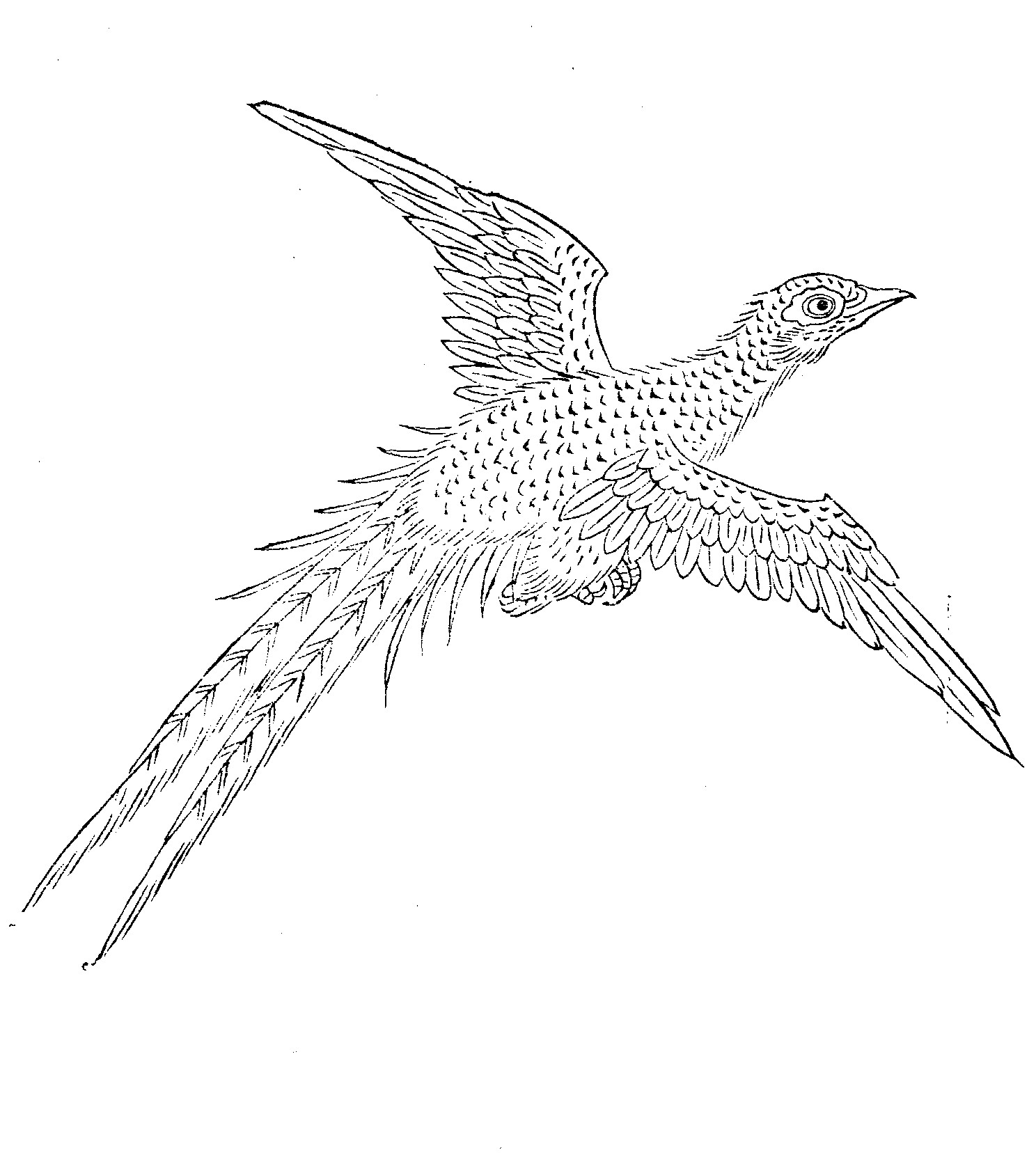
A small bird, the size and shape of a crow: head marked with fine patterns, beak white, feet red. In later Chinese bestiary illustration she is shown mid-flight over grey waves, a twig or a pebble held in her beak, the sea enormous beneath her.
✨ Abilities
- Self-naming cry — its call sounds out 'jing-wei,' keeping her human name alive; the Shanhaijing phrase 'its cry calls itself' marks her as a person, not a beast
- The endless bearing — tirelessly carries twigs and stones from the Western Hills to drop into the Eastern Sea; neither distance nor repetition wears her down
- Deathless grudge — drowned once, she cannot be drowned again; a spirit that persists past death out of sheer refusal
- Vow against the water — later lore (述異記) has her swear never to drink from the sea that killed her; the spot of the vow was still pointed out on the coast
- Small arithmetic of vengeance — each pebble is negligible, yet the account never closes; the sea is diminished one mouthful at a time
🏮 Symbolism
Unyielding will against impossible odds — the idiom 'jingwei fills the sea' (精卫填海) is a living Chinese chengyu for dogged perseverance, seeded by Tao Yuanming's 5th-century poem pairing her with the headless warrior Xingtian ('fierce resolve endures forever'). Lu Xun cited those lines in 1935 to argue Tao was 'not all serenity,' and in the 20th century the myth was read as the spirit of resistance itself. Modern angles: she recurs in games and animation (the manhua and donghua Fei Ren Zai turns her into a comedic modern woman who cannot stop filling cups and potholes), she is a popular tattoo motif of stubborn endurance, and 'Jingwei' is a go-to name for brands and gamer tags that want to signal refusal to quit.
🎬 Cultural References
| Work | Year | Note |
|---|---|---|
| Shanhaijing Illustrated, with Encomia (山海經圖贊) | 4th c. CE | Guo Pu's four-line verse on the illustration — 'her body sank into the Eastern Sea; her bright spirit journeyed west' |
| Reading the Classic of Mountains and Seas, no. 10 (讀山海經·其十) | c. 400 | Tao Yuanming pairs Jingwei with Xingtian — 'fierce resolve endures forever'; the founding text of the perseverance reading |
| Lament for the South (哀江南賦) | c. 578 | Yu Xin: 'can the wronged bird ever fill the sea?' — the impossible-task trope enters high literature |
| Jingwei Fills the Sea (精卫填海, TV series) | 2005 | Mainland fantasy series starring Shu Chang that repopularized the myth for a television generation |
| Fei Ren Zai (非人哉, 'Non-Humans') | 2015 | Web manhua (donghua 2018) whose Jingwei is a modern woman pathologically compelled to fill cups, pools and potholes — the meme version of the myth |
A Princess Drowned in the Eastern Sea
Inside the dry inventory of the Classic of Mountains and Seas — mountain after mountain, river flowing into river — the entry for Mount Fajiu stops the reader cold. A bird shaped like a crow, white-beaked and red-footed, cries out its own name. The text then explains, in one compressed sentence, what that cry means: this is Nüwa, the youngest daughter of the Flame Emperor (Yandi), who went swimming in the Eastern Sea, drowned, and never came back. What returned instead was Jingwei.
Note the honesty of the source. The Shanhaijing names no villain: no dragon, no negligent sea god — only water, and a girl it killed. Her vengeance is aimed at the sea itself, the nearest thing to an indifferent cosmos that archaic China could picture.
The Impossible Task
Her project is mathematically absurd: to dam the Eastern Sea with twigs and pebbles carried from the Western Hills, hundreds of li away. The text states it flatly — ever carrying wood and stone, to dam up the Eastern Sea — with no promise of success and no stated ending. That flatness is the power of the myth. Later readers supplied the moral. Guo Pu’s 4th-century encomium makes it explicit: her body sank, her bright spirit journeyed west — and then she went back to work. The dead do not rest; they file appeals.
Vows, Mates, and Other Names
By the time of Ren Fang’s 6th-century Records of Marvels (述異記), folklore had thickened around the bird. Jingwei calls her own name as she flies; she swore never to drink from the water that drowned her, and the spot of that vow was still being pointed out on the coast. Finding no mate of her own kind, she paired with a storm petrel — daughters born shaped like Jingwei, sons like the petrel. The tradition piles on epithets that read like a personality study: the Vow Bird (誓鳥), the Wronged Bird (冤禽), the Bird of Resolve (志鳥), and the homely folk name Emperor’s Daughter Sparrow (帝女雀). One transmitted edition even garbles the first of these into 鳥誓 — a small reminder that our textual base for ‘minor’ myth is thin and slippery, and this bestiary prefers to say so.
From Wronged Bird to National Metaphor
The decisive re-reading came from Tao Yuanming (c. 400 CE), whose poem pairs Jingwei with Xingtian, the headless warrior still brandishing shield and axe: ‘fierce resolve endures forever.’ Where the Shanhaijing offers an unsettling vignette, Tao offers a doctrine — persistence as a form of immortality. Yu Xin’s 6th-century Lament for the South turns it tragic: can the wronged bird ever fill the sea? And Lu Xun, in his 1935 essay drafts, cited Tao’s very lines to argue that China’s great quietist was ‘not all serenity.’
By the twentieth century, 精卫填海 — ‘Jingwei fills the sea’ — had crystallized into a standard chengyu for dogged, seemingly hopeless perseverance, and the story was taught to every schoolchild as the parable of the unbreakable will. One caution for the careful reader: it is easy, and probably wrong, to file the myth as simple inspiration. The oldest text leaves its queasiness intact. A child is dead, the sea does not notice, and the work goes on anyway. Whether that is heroism or open trauma depends on which shore you stand on.
🎲 D&D 5E: See the full stat block in the lore box below. CR 4 undead, neutral good.
🎲 D&D 5E Stat Block
AC 13 (natural), HP 58 (9d6+27), Speed 20 ft., fly 60 ft. (hover). STR 8, DEX 16, CON 14, INT 10, WIS 14, CHA 15. Immutable Resolve: advantage on saves against being charmed or frightened, and it can't be magically compelled to abandon a chosen task. Undying Grudge: regains 10 HP at the start of each of its turns while it can see the sea. Multiattack: one beak +5 (1d6+3 piercing) and one talon +5 (1d4+3 slashing). Wood and Stone (Recharge 5-6): a 20-ft. cube within 60 ft. is pelted with enchanted debris; DC 13 Dex save, 22 (4d10) bludgeoning damage, and the area becomes difficult terrain.