Bifang 毕方
bì fāng · Wade-Giles: pi-fang
Fierce Beast 凶兽
📜 Source Text 原文出处
西山经 · 西次三经 · 章莪之山 · Classic of the Mountains: West — Third Series (Xi Ci San Jing), Mount Zhang'e
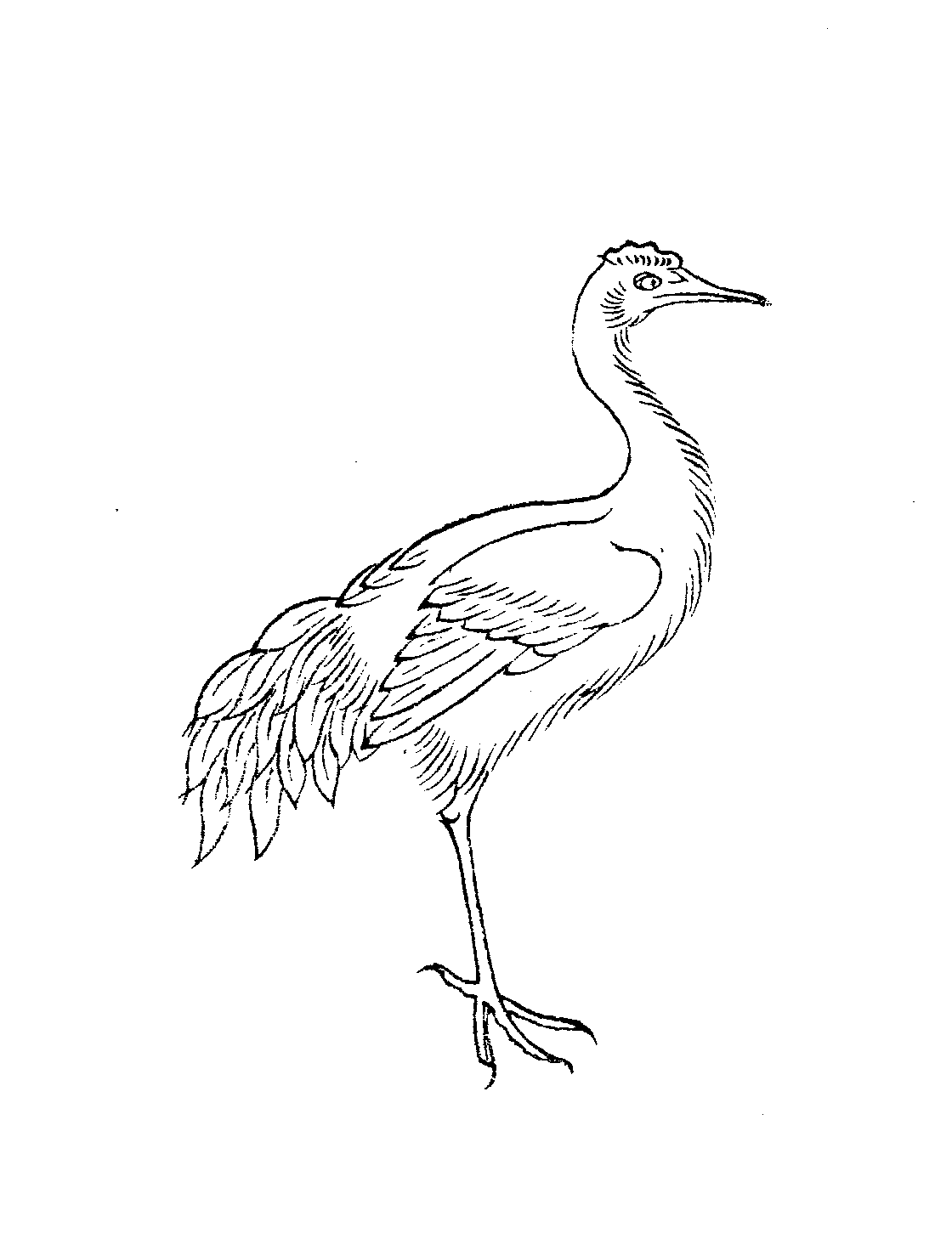
有鸟焉,其状如鹤,一足,赤文青质而白喙,名曰毕方,其鸣自叫也,见则其邑有讹火。
There is a bird there shaped like a crane, with a single leg, red markings on a blue-green body, and a white beak. Its name is Bifang. Its cry calls out its own name — and whenever it appears, the district is struck by ehuo, a strange and unaccountable fire.
Guo Pu's commentary (c. 320 CE) glosses the character: 'ehuo (讹火) is written with the character for prodigy — an uncanny fire.'
毕方鸟在其东,青水西,其为鸟一脚。一曰在二八神东。
The bifang bird lies to its east, west of the Greenwater. The bird has but one foot. Another tradition places it east of the Two-Eight spirits.
From the Classic of Regions Beyond the Seas: South (海外南经); some editions read 其为鸟人面一脚 — the bird has a human face and a single foot.
山出枭阳,水生罔象,木生毕方,井生坟羊,人怪之,闻见鲜而识物浅也。
The mountains breed the xiaoyang, the waters breed the wangxiang, the trees breed the bifang, the wells breed the fenyang. People marvel at them only because their experience is narrow and their knowledge of things shallow.
From the Huainanzi, 'Fanlun' (淮南子·氾论训), c. 139 BCE. Gao You's Han commentary: 'Bifang is the essence of wood (木之精), shaped like a bird — blue-green, red-footed, one-legged, and does not eat grain.'
昔者黄帝合鬼神于泰山之上,驾象车而六蛟龙,毕方并辖,蚩尤居前。
In ancient days the Yellow Emperor assembled the spirits upon Mount Tai, driving an elephant carriage drawn by six dragons; Bifang held the reins beside him, and Chiyou marched at the fore.
From the Han Feizi, 'Ten Faults' (韩非子·十过) — here Bifang is a deity at the Yellow Emperor's chariot, an older stratum than the fire-omen bird. Some editions write 毕方并鎋 (鎋, a variant of 辖 'reins') and 西泰山 for Mount Tai.
Modern location: Not securely identified; the text's chain of distances places Mount Zhang'e deep in the western ranges, 280 li west of Mount Changliu.
📝 Summary
The bifang (毕方) is a one-legged bird of the Classic of Mountains and Seas (c. 4th century BCE): shaped like a crane, red-marked on a blue-green body, white-beaked, and crying its own name. Where it appears, the text says, the district will suffer ehuo — a strange, uncanny fire. Later writers made it the essence of wood and the fixed omen-bird of conflagration.
🎨 Appearance
A crane-like bird balanced on a single leg: blue-green plumage streaked with red markings, a white beak, and — in one textual tradition — a human face. Han commentator Gao You adds red feet and a grain-free diet; a later gloss turns it into a winged old man bearing fire.
✨ Abilities
- Omen of the ehuo — its appearance over a settlement foretells a strange fire (讹火, 'prodigy fire') raging through the district
- Self-naming cry — its call speaks its own name (其鸣自叫), so the word 'bifang' travels ahead of the flames; Yuan Ke read the name as onomatopoeia for the crackle of kindling
- Essence of wood — Han lore (Huainanzi; Gao You's gloss) makes it the wood-spirit 木之精: blue-green, red-footed, one-legged, abstaining from grain
- Firebearer — Xue Zong's Three Kingdoms gloss on Zhang Heng's fu: an 'old-father god' like a bird, always carrying fire and working uncanny disasters in people's houses
- Chariot-deity — an older stratum in the Han Feizi: a spirit named Bifang holds the reins of the Yellow Emperor's elephant carriage
🏮 Symbolism
A walking fire-alarm of the ancient world: where the fenghuang announced virtue, the bifang announced that the granaries would burn — omen, warning, and (since its cry was heard in the crackling of kindling) the very voice of combustion itself. Wood-essence lore folded it into Five Phases thought, wood feeding fire. Modern angles: in the mobile RPG Shanhai Jing Hua (2020) it endures as a fire-omen bird spirit, and online bestiary culture debates its pedigree against the fenghuang and Jingwei — sibling birds of the same classic sorted into auspicious and calamitous bloodlines.
🎬 Cultural References
| Work | Year | Note |
|---|---|---|
| Huainanzi, 'Fanlun' (淮南子·氾论训) | c. 139 BCE | 木生毕方 — listed among prodigies bred from wood; Gao You's commentary made it the canonical 'essence of wood' |
| Wen xuan, Zhang Heng's 'Dongjing fu' (文选·东京赋) | c. 107 | Xue Zong's gloss: an old-father god like a bird with two legs and one wing, carrying fire into houses (Liang Zhangju later argued it should read one leg, two wings) |
| Liu Zongyuan, 'Zhu Bifang wen' (柳宗元《逐毕方文》) | c. 806 | Tang exorcism essay after the Yongzhou fires: 'a strange bird, none could verify its form... could this be the bifang?' |
| Pianya, 'Shi niao' (骈雅·释鸟) | Ming dynasty | Zhu Mouhan's glossary defines it in four characters: 兆火鸟 — 'the bird that foretells fire' |
| Shanhai Jing Hua (山海镜花) | 2020 | Mobile RPG built on the classic; Bifang appears as the chapter-one boss and a playable fire spirit |
The Bird That Names Itself
The Classic of Mountains and Seas hides the bifang in one of its strangest landscapes: Mount Zhang’e (章莪之山), a peak with no grass and no trees, rich in jasper-green jade, and — in the text’s own words — a place where “very uncanny things occur” (所為甚怪). The bird shares the mountain with the zheng, a red leopard with five tails and a single horn. Of the bifang itself the text is brisk: crane-shaped, one-legged, red markings on a blue-green body, white beak. Its cry calls out its own name, so that “bifang” rings through the hills before anything burns. Then comes the formula that fixed the creature’s fate: see it, and your district will suffer an ehuo — a strange fire, glossed by the early commentator Guo Pu as “an uncanny, prodigious flame.” The modern mythologist Yuan Ke (袁珂) went further, arguing that the name itself is onomatopoeia — the sharp crackle of bamboo and timber catching fire — and identifying the bifang with the “fire crow” (火老鸦) of later folklore. On this reading the bird is less an animal than combustion given a voice.
Crane, God, or Essence of Wood?
No single tradition owns the bifang; at least three ancient strands converge on the name, and a bestiary should admit the tangle rather than hide it. The Classic of Regions Beyond the Seas: South locates the bird west of the Greenwater and gives it one foot — though some editions arm it with a human face as well (人面一腳). The Han Feizi, telling of the Yellow Emperor’s great assembly of spirits on Mount Tai, makes Bifang the deity who holds the reins of the imperial elephant carriage — a dignified office, and a much older one than the fire omen. The Huainanzi (c. 139 BCE) files it flatly among nature’s prodigies: mountains breed the xiaoyang, waters the wangxiang, trees the bifang, wells the fenyang — and people gawk only because they have seen little. Gao You’s commentary to that line supplied the reading that dominates later tradition: the bifang is the essence of wood (木之精), a blue-green, red-footed, one-legged bird that never touches grain. A third-century gloss on Zhang Heng’s “Dongjing fu” disagrees with everyone, describing an “old-father god” shaped like a bird with two legs and one wing, forever carrying fire into people’s houses; the Qing scholar Liang Zhangju suspected the text should read one leg and two wings instead. Whether these are one being in decaying memory or several beings fused by a shared name is a question the sources never answer.
The Exorcist’s Fire-Bird
Han and Tang omen culture gave the bifang its working life. The Wen xuan preserves Zhang Heng’s line on the spirits trembling before “the jiyu and the bifang”; the Ming glossary Pianya compresses the whole dossier into four characters — zhaohuo niao (兆火鸟), “the bird that foretells fire.” The fullest literary portrait is an exorcism: after fires raged night after night in Yongzhou, Liu Zongyuan composed his Zhu Bifang wen (c. 806), a formal expulsion addressed to the creature — “a strange bird, none could verify its form… could this be the bifang?” The essay half-believes itself, which is precisely its charm: by the Tang, blaming the bifang was already tradition as much as terror. From such texts and the stage lore built on them, the “one-legged crane” (独脚鹤) hardened into a stock herald of calamity — the bird you draw when you want the audience to smell smoke before the first spark.
From Omen to Game Sprite
The bifang’s modern afterlife keeps the fire. The mobile RPG Shanhai Jing Hua (2020) opens its campaign with a half-mad, flame-feathered bifang and keeps it as a playable fire spirit; across games, web fiction, and tattoo flash the name has become shorthand for a beautiful thing that burns what it touches. Popular bestiary culture now sorts it into a taxonomy of Chinese birds: against the fenghuang, the auspicious fire of righteous rule, and Jingwei, the drowning girl’s vengeful little bird, the bifang is the calamitous brother — the one whose appearance means no rescue is coming, only the bell and the bucket brigade.
🎲 D&D 5E: See the full stat block in the lore box below. CR 9 monstrosity, chaotic neutral.
🎲 D&D 5E Stat Block
AC 16 (natural), HP 176 (16d10+88), Speed 30 ft., fly 90 ft. STR 12, DEX 18, CON 16, INT 11, WIS 15, CHA 16. Fire immunity, Magic Resistance, Flyby. Multiattack: 2 flame talons +8 (2d6+4 slashing plus 10 (3d6) fire). Eruption of Omen-Fire (Recharge 5-6): each creature in a 30-ft. radius within 120 ft., DC 16 Dex, 54 (12d8) fire, and unattended flammable objects ignite; the flames spread unnaturally and cannot be doused by water for 1 hour. Harbinger of the Estranged Flame: at each dawn while the bifang lairs within 1 mile of a settlement, every nonmagical flame there doubles its reach.